
Apache APISIX Ingress Controller 2.0 is officially released. It delivers comprehensive Gateway API support, flexible multi-data-plane deployment, and etcd-free operation for robust, scalable Kubernetes traffic management.
Built on the high-performance API gateway Apache APISIX, APISIX Ingress Controller has undergone multiple iterations and validations, and is now capable of handling large-scale traffic management demands. The Apache APISIX community is pleased to announce the official release of APISIX Ingress Controller 2.0. This release delivers substantial enhancements across three foundational pillars—comprehensive compatibility, adaptable architecture, and enterprise-grade stability—empowering users to migrate their technology stacks smoothly and reliably.
Highlights of Apache APISIX Ingress Controller 2.0
Support Gateway API
This release achieves a significant milestone in Gateway API coverage with the addition of TCPRoute, UDPRoute, GRPCRoute, and TLSRoute. These extensions provide native, protocol-aware routing for a wide range of traffic types—from traditional HTTP and TCP/UDP to modern gRPC and TLS passthrough/termination. This unified support allows organizations to manage diverse ingress requirements within a consistent, future-ready configuration model, simplifying multi-protocol deployment and easing the transition to full Gateway API adoption.
Introduce Gateway API Extensions
Building upon adherence to the Gateway API design principles, APISIX Ingress Controller 2.0 introduces a set of API extensions under apisix.apache.org/v1alpha1 based on the Gateway API. These extensions provide additional capabilities not currently directly covered by the standard Gateway API, while maintaining the core semantics and usage patterns of the standard resources. They are designed to meet more complex and diverse real-world usage scenarios.
GatewayProxy: It defines the connection between the APISIX Ingress Controller and the APISIX, including auth, endpoints, and global plugins. It is referenced via
parametersRefin Gateway, GatewayClass, or IngressClass resources.BackendTrafficPolicy: It is for fine-grained traffic management of backend services, including load balancing, timeouts, retries, and host header handling in the APISIX Ingress Controller.
Consumer: It defines API consumers and their credentials, enabling authentication and plugin configuration for controlling access to API endpoints.
PluginConfig: It defines reusable plugin configurations that can be referenced by other resources like HTTPRoute, enabling separation of routing logic and plugin settings for better reusability and manageability.
HTTPRoutePolicy: It configures advanced traffic management and routing policies for HTTPRoute or Ingress resources, enhancing functionality without modifying the original resources.
These extensions offer a standardized, vendor-supported path to leverage advanced APISIX features directly within the Gateway API ecosystem.
Support APISIX Standalone API-Driven Mode
APISIX Ingress Controller 2.0 offers a lightweight, etcd-free deployment option through its Standalone API-Driven Mode.
This deployment paradigm stores routing configurations entirely in memory rather than in a configuration file. Updates are performed through a dedicated Standalone Admin API, which replaces the full configuration in a single operation and takes effect immediately via hot reloading, without requiring a restart.
This mode is designed specifically for the APISIX Ingress Controller and is primarily intended for integration with ADC (API Declarative CLI).
Support Multi-Data-Plane Deployment Mode
This release introduces flexible deployment options supporting multiple data plane modes, enabling a single ingress controller to manage several independent APISIX instances. This approach is ideal for environments requiring strict isolation—such as multi-tenancy, staging vs. production, or region-based routing—while maintaining centralized control.
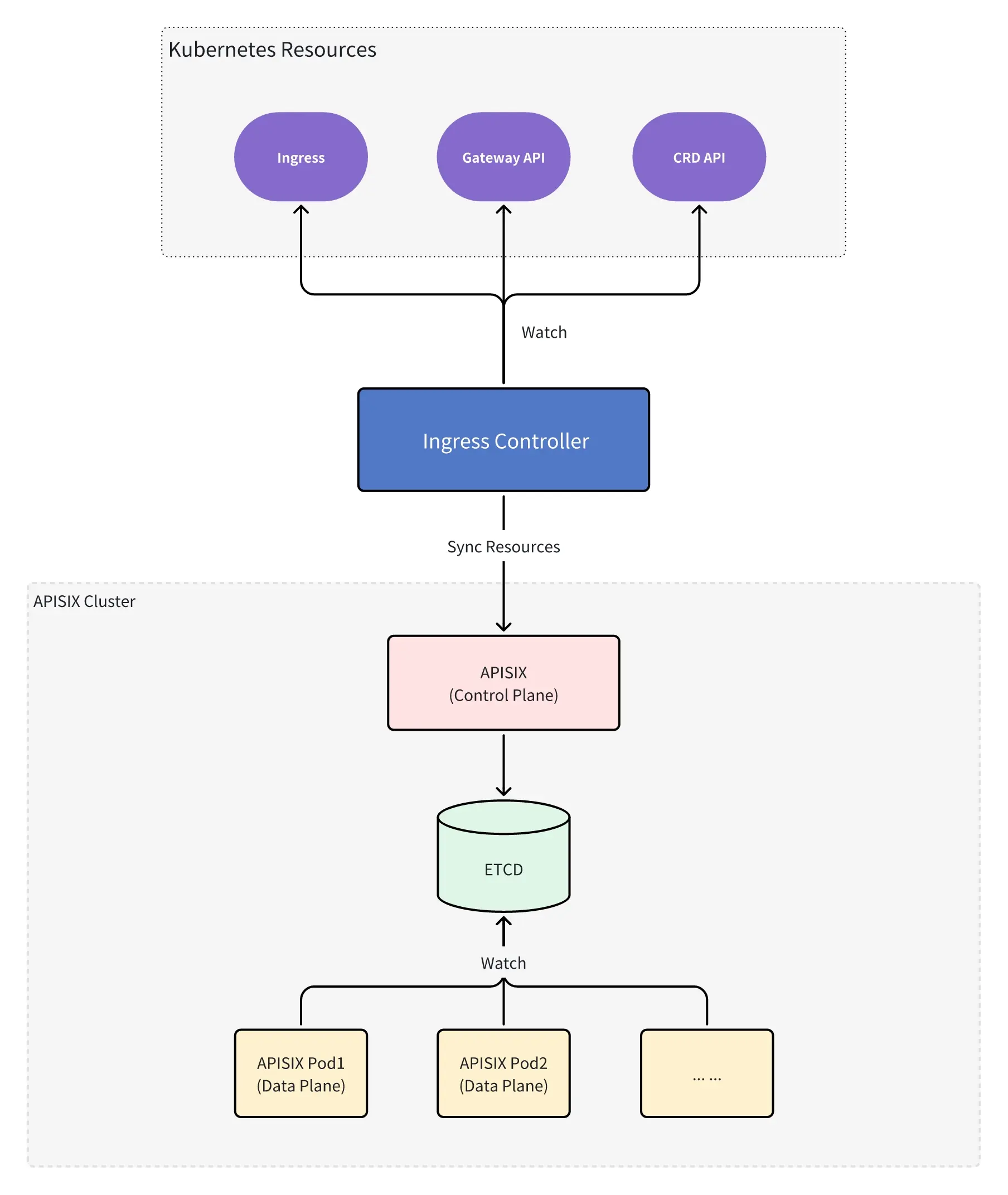
Admin API Mode
In the traditional deployment approach, APISIX uses etcd as its configuration center, allowing administrators to dynamically manage routes, upstreams, and other resources through RESTful APIs. It supports distributed cluster deployments with real-time configuration synchronization.
Standalone Mode
APISIX can also run independently without relying on etcd, which is especially well‑suited for Kubernetes and single‑node deployments. It stores configurations in memory and manages them through the dedicated /apisix/admin/configs endpoint.
This mode is particularly suitable for Kubernetes environments and single-node deployments, where the API-driven memory management approach combines the convenience of traditional Admin API with the simplicity of Standalone mode.
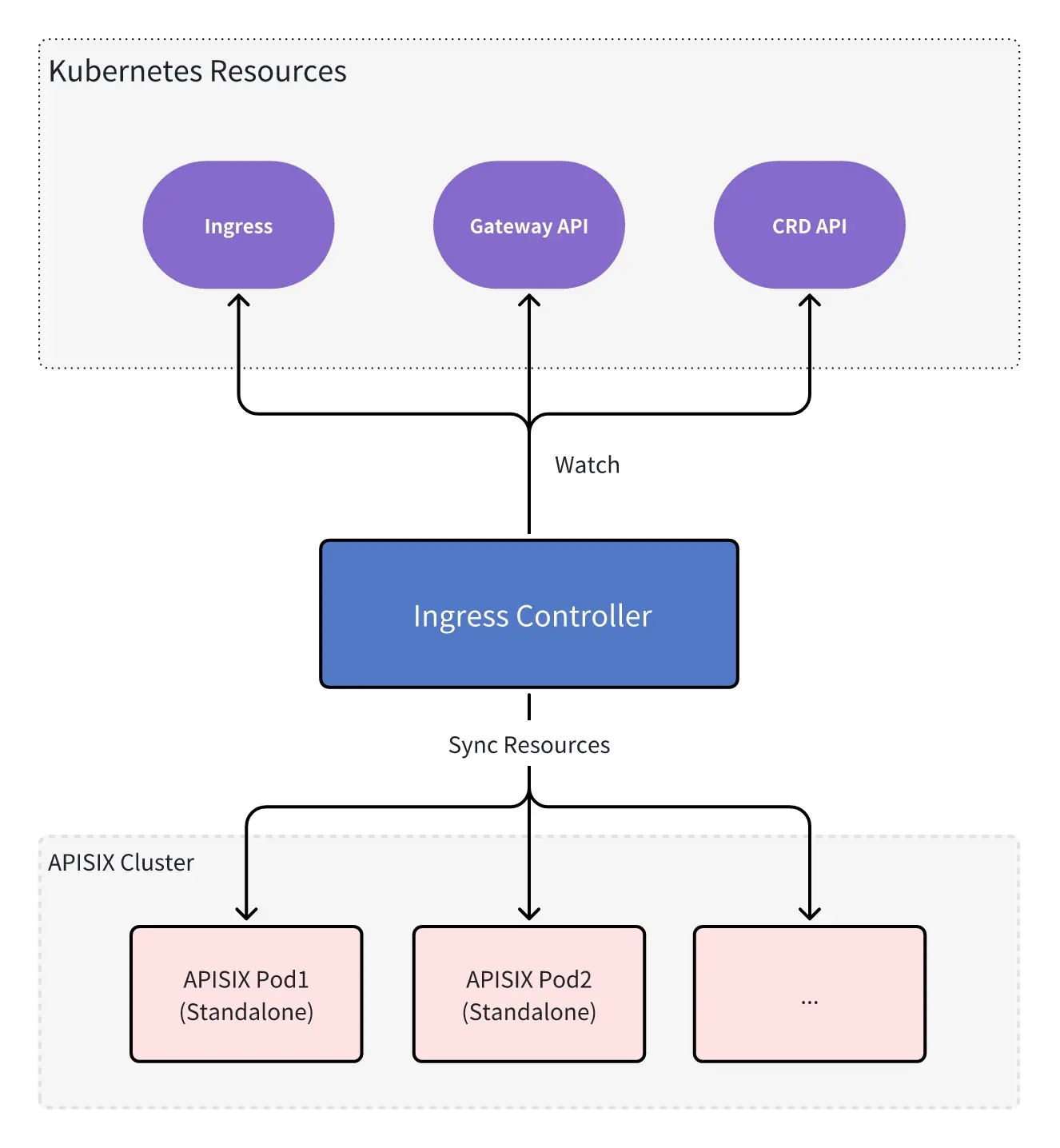
This multi-mode strategy empowers organizations to tailor their ingress architecture to diverse requirements without sacrificing manageability or control.
Conclusion
Apache APISIX Ingress Controller 2.0 represents a significant evolution in Kubernetes ingress management, delivering a robust platform built for the complexity of modern, multi-protocol applications. By uniting comprehensive Gateway API support, extensible configuration through official API extensions, a lightweight standalone deployment mode, and versatile multi-data-plane management, this release provides a cohesive and powerful foundation for dynamic cloud environments.
Whether you are standardizing ingress across diverse workloads, seeking greater architectural flexibility, or requiring enterprise-grade stability at scale, APISIX Ingress Controller 2.0 offers a forward-looking solution that simplifies operations without compromising capability. It stands as a testament to the community-driven innovation within the Apache APISIX ecosystem, designed to meet today's demands while adapting to tomorrow's challenges.
For a complete list of features and changes, please refer to the Release Changelog.