2026 Monthly Report (October 01 - October 31)
Recently, we’ve introduced and updated features for Prometheus observability, multi-cluster service discovery, compressed request handling, verified identity propagation, and WAF resilience. For more details, please read this month’s newsletter.
Introduction
From its inception, the Apache APISIX project has embraced the ethos of open-source community collaboration, propelling it into the ranks of the most active global open-source API gateway projects. The proverbial wisdom of ‘teamwork makes the dream work’ rings true in our way and is made possible by the collective effort of our community.
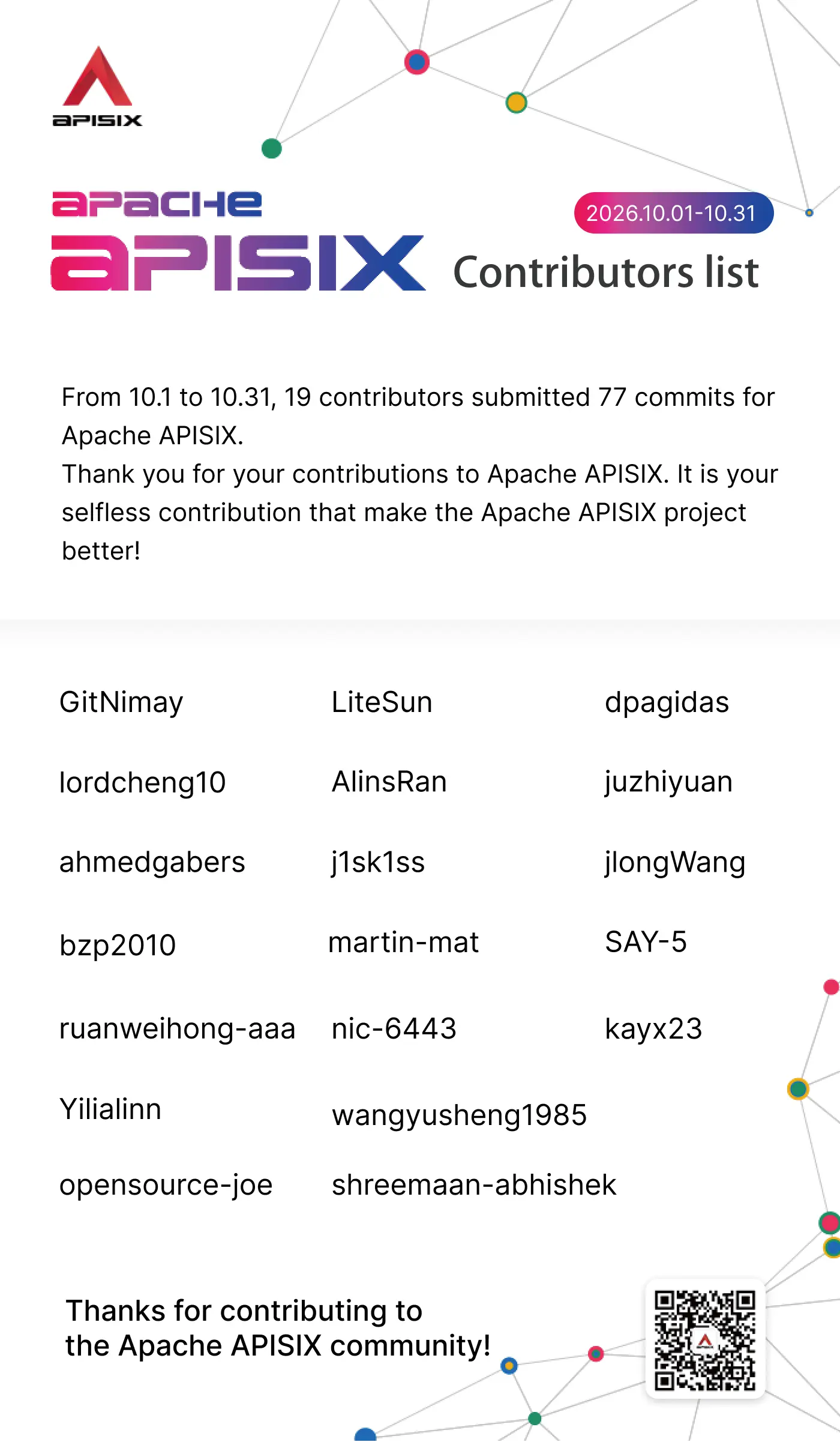
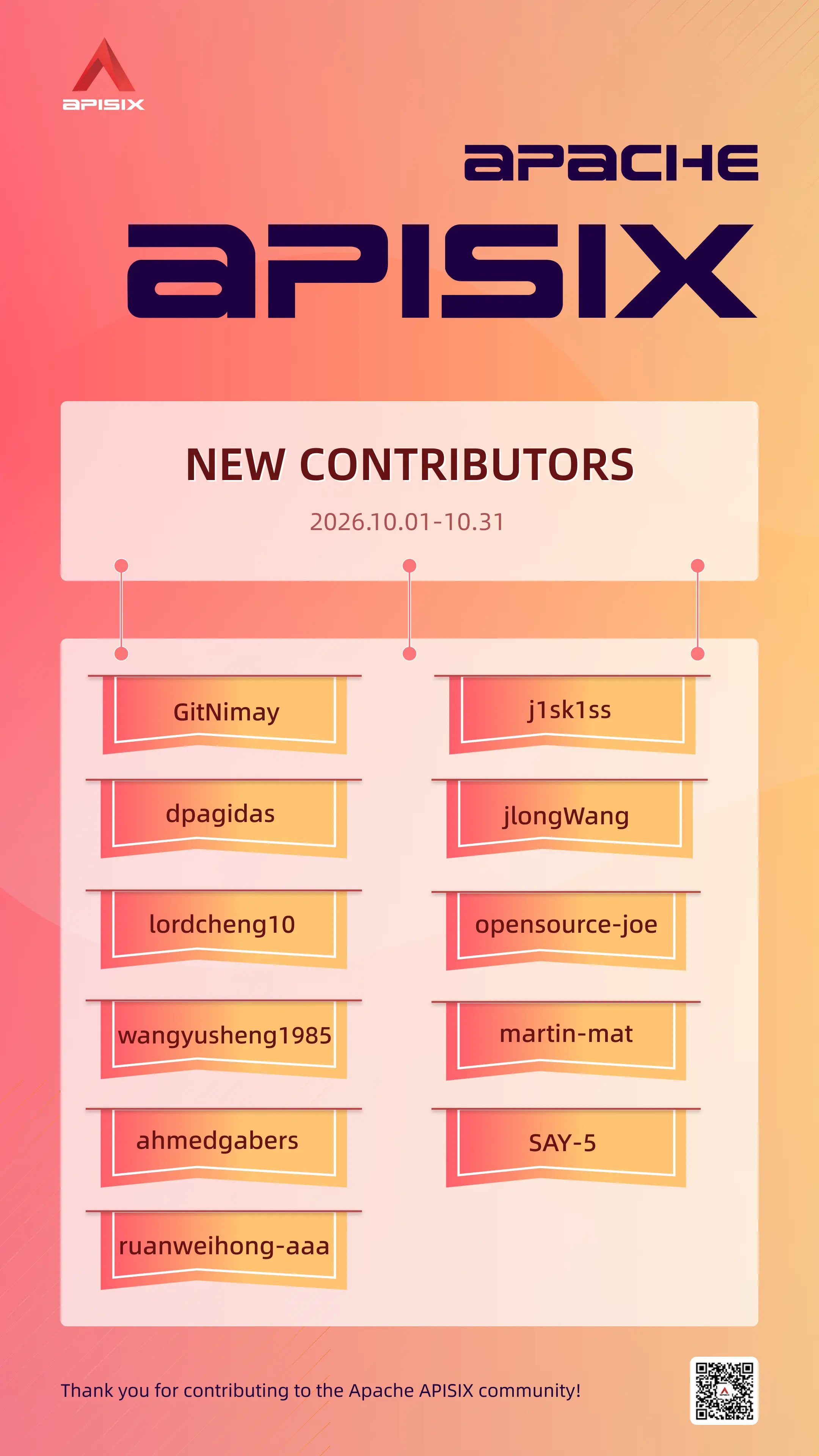
From October 1st to October 31st, 19 contributors made 77 commits to Apache APISIX. We sincerely appreciate your contributions to Apache APISIX.
Contributor Statistics
Feature Highlights
Here are the key updates from this month, grouped by capability area.
Observability and Traffic Governance
1. Attribute Stream Metrics to Services
PR: https://github.com/apache/apisix/pull/13992
Contributor: AlinsRan
APISIX now adds service and service_id labels to its four stream Prometheus metrics, making per-service traffic visible even when services share ports. Existing series gain empty versions of both labels, so alerts that select a single unaggregated series may need updated selectors. For sessions rejected before the stream Prometheus plugin runs, active-connection and bandwidth data remain in unlabelled totals, while apisix_stream_status still attributes the session to its service.
2. Export Per-Process OpenResty Resource Metrics
PR: https://github.com/apache/apisix/pull/14034
Contributor: nic-6443
New Prometheus gauges expose timer usage, connection-slot consumption, and Lua memory for each worker and the privileged agent, helping operators detect process-local exhaustion before it causes errors. Collection runs only when the Prometheus plugin is enabled, and runtime layout guards suppress connection gauges rather than publish incorrect values when the expected NGINX structure is not detected.
3. Configure Expired Prometheus Metric Cleanup
PR: https://github.com/apache/apisix/pull/13981
Contributor: AlinsRan
Operators can now set plugin_attr.prometheus.remove_expired_keys_interval for HTTP and stream metrics instead of relying on a fixed library default. The default remains 3,600 seconds, values above that are capped by the library, and non-positive values disable cleanup; after a reload, a shorter interval may not take effect until the previously scheduled interval expires.
4. Explain Rate-Limiting Decisions in Logs
PR: https://github.com/apache/apisix/pull/13996
Contributor: nic-6443
The $rate_limiting_info variable now reports fixed- or sliding-window timestamps, request cost, decision, counters, and delayed-sync details so access logs can explain why a request was allowed, rejected, or failed. This is an observability-only change with no additional Redis call or decision change; the variable is JSON-encoded, so consumers must not depend on field order and should allow documented null values when a code path lacks a value.
Service Integration and Request Handling
5. Select Multiple Kubernetes Discovery Clusters
PR: https://github.com/apache/apisix/pull/13991
Contributor: AlinsRan
Kubernetes discovery now accepts discovery_args.cluster_ids, allowing an upstream to use the deduplicated union of endpoints from an explicit set of clusters. Unlisted clusters never contribute nodes and there is no fallback when none of the selected clusters has matching endpoints; the Admin API validates cluster IDs, while stale or unknown IDs that reach the data plane are skipped with a warning.
6. Connect to Consul over HTTPS
PR: https://github.com/apache/apisix/pull/14018
Contributor: nic-6443
Consul discovery can now connect to HTTP and HTTPS server addresses in the same server list, using port 443 when an HTTPS address omits its port. Certificate verification is enabled by default against apisix.ssl.ssl_trusted_certificate; operators may set discovery.consul.ssl_verify: false for self-signed environments, while unsupported schemes continue to be rejected.
7. Decompress Request Bodies for Downstream Plugins
PR: https://github.com/apache/apisix/pull/14016
Contributor: shreemaan-abhishek
The new request-decompress plugin inflates gzip and deflate request bodies before validation, WAF inspection, transformation, and other body-reading plugins run. It enforces max_req_body_size while streaming decompressed output and can optionally restore or recompress the body before proxying; decompression happens before authentication by default, so operators should size both body limits to bound unauthenticated work.
8. Remove the Deprecated MCP Bridge Plugin
PR: https://github.com/apache/apisix/pull/14019
Contributor: shreemaan-abhishek
APISIX has removed the deprecated mcp-bridge plugin, its transports, documentation, tests, and related CI setup, while retaining the mcp-session shared dictionary for openapi-to-mcp when that plugin is enabled. This is a breaking change: users who still list mcp-bridge in their plugins configuration must remove it and should use openapi-to-mcp for MCP integration going forward.
Identity and Security Resilience
9. Map Verified OpenID Connect Claims to Headers
PR: https://github.com/apache/apisix/pull/14030
Contributor: shreemaan-abhishek
The openid-connect plugin can now map selected verified claims to upstream request headers through upstream_headers, including nested claims and claim names containing punctuation. Every declared header is cleared on all authentication outcomes before a verified value is set, preventing client spoofing; arrays and objects are forwarded as base64-encoded JSON, while missing, null, false, and empty-string values produce no header.
10. Distinguish Token Failures from Introspection Outages
PR: https://github.com/apache/apisix/pull/14088
Contributor: shreemaan-abhishek
Upgrading lua-resty-openidc to 1.9.3 lets APISIX return 401 for confirmed inactive tokens, 503 for introspection endpoint or transport failures, and 500 for configuration errors. Concurrent misses can share an in-flight result, but coordination remains best effort and falls back to direct introspection on timeout; missing or non-boolean active claims are now rejected as invalid upstream responses.
11. Allow Chaitin WAF to Fail Open
PR: https://github.com/apache/apisix/pull/13311
Contributor: jlongWang
The Chaitin WAF plugin adds an allow_degradation option that lets requests proceed when the WAF service is unavailable, including connection timeouts, missing healthy nodes, and detection errors. The option defaults to false, preserving fail-closed behavior unless operators explicitly choose availability over enforcement during a WAF outage.
Conclusion
The official website and GitHub Issues of Apache APISIX provide a wealth of documentation, tutorials, and real-world use cases. If you encounter any issues, you can refer to the documentation, search for keywords in Issues, or participate in discussions on Issues to share your ideas and practical experiences.