2026 Monthly Report (August 01 - August 31)
Recently, we’ve introduced and updated some new features, including advanced LDAP and OIDC authentication, stronger encryption and upstream TLS verification, faster and more resilient AI traffic, and richer traffic governance and observability. For more details, please read this month’s newsletter.
Introduction
From its inception, the Apache APISIX project has embraced the ethos of open-source community collaboration, propelling it into the ranks of the most active global open-source API gateway projects. The proverbial wisdom of ‘teamwork makes the dream work’ rings true in our way and is made possible by the collective effort of our community.
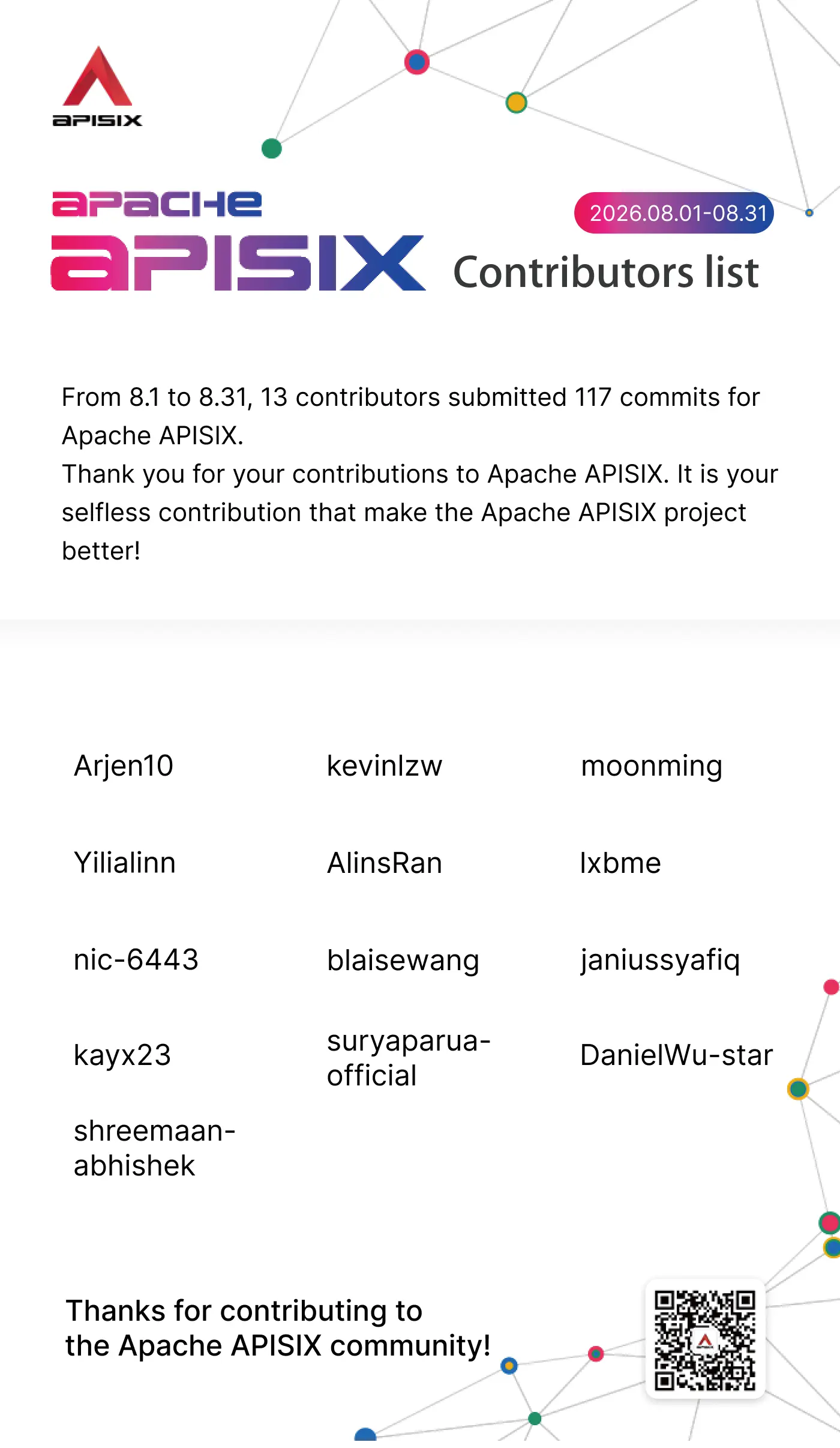
From August 1st to August 31st, 13 contributors made 117 commits to Apache APISIX. We sincerely appreciate your contributions to Apache APISIX.
Contributor Statistics
Feature Highlights
Here are the key updates from this month, grouped by capability area.
Authentication and Credential Protection
1. Add the ldap-auth-advanced Plugin for Core Authentication
PR: https://github.com/apache/apisix/pull/13762
Contributor: janiussyafiq
This PR adds the ldap-auth-advanced plugin with LDAP search-then-bind, service-account or anonymous search, user_dn Consumer association, LDAPS/StartTLS, and protection against LDAP filter injection. It also upgrades lua-resty-ldap so tls_verify: true performs actual certificate verification and separates authentication failures from directory or transport errors.
2. Support PAR and DPoP Client Options in openid-connect
PR: https://github.com/apache/apisix/pull/13649
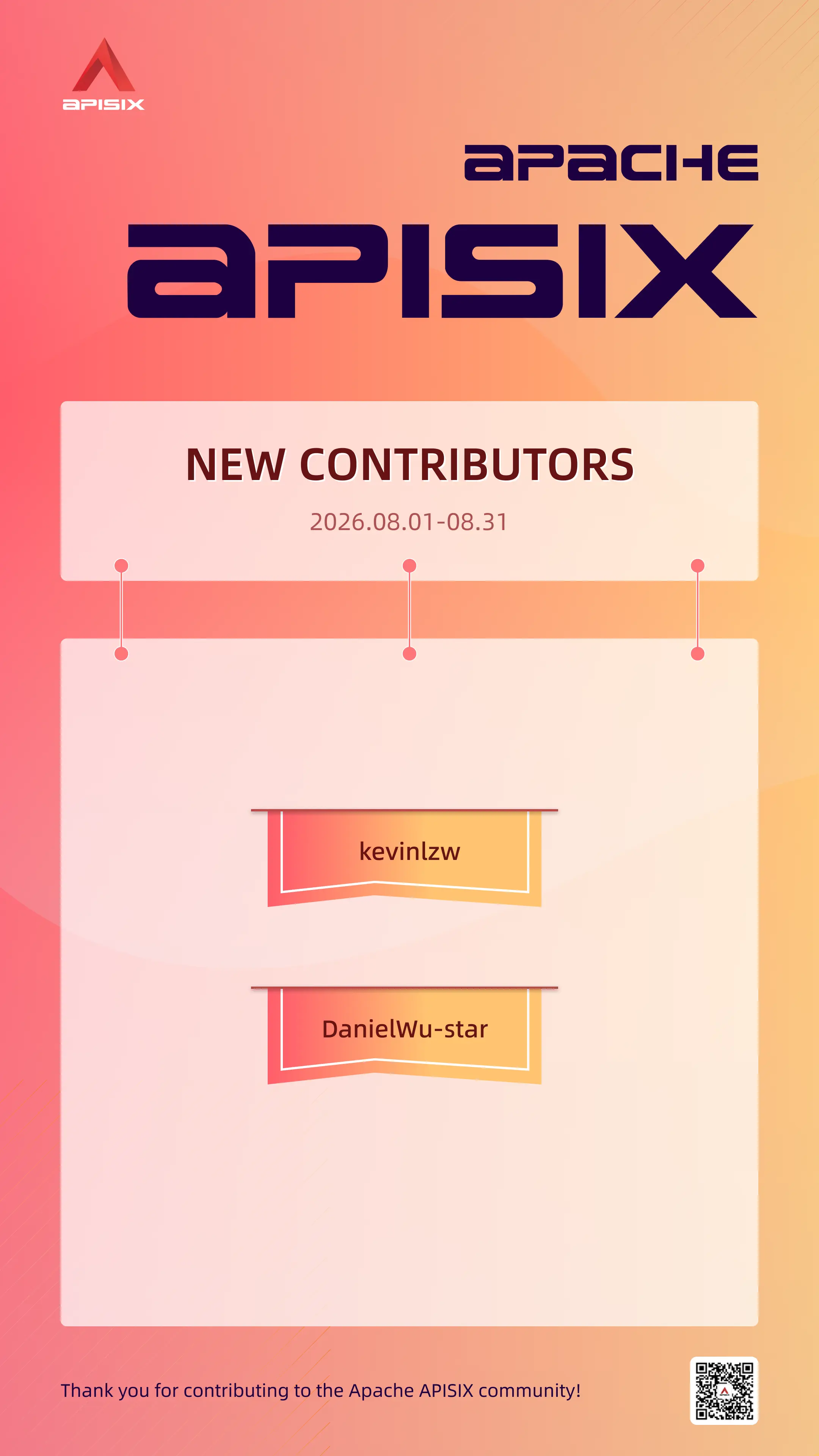
Contributor: kevinlzw
This PR exposes OAuth 2.0 Pushed Authorization Requests, DPoP proof generation for token and userinfo requests, and client assertion algorithm and audience options through the openid-connect plugin. The new settings are opt-in, DPoP private keys are encrypted in etcd, and existing configurations retain their previous behavior.
3. Hide LDAP Credentials from Upstreams
PR: https://github.com/apache/apisix/pull/13832
Contributor: nic-6443
This PR adds a hide_credentials option to ldap-auth, allowing APISIX to remove the LDAP Basic Authentication header before proxying a request upstream. The option defaults to false for backward compatibility while helping operators avoid exposing reusable organization-wide credentials to backend services.
Encryption and Upstream Security
4. Support AES-256 Keys in the Encryption Keyring
PR: https://github.com/apache/apisix/pull/13756
Contributor: AlinsRan
This PR lets APISIX data encryption use either 16-byte AES-128 keys or 32-byte AES-256 keys and rejects unsupported key lengths. A keyring can contain both sizes, enabling operators to rotate from AES-128 to AES-256 without losing access to data encrypted with an older key.
5. Verify Upstream Certificates Against Configurable CAs
PR: https://github.com/apache/apisix/pull/13863
Contributor: nic-6443
This PR makes upstream.tls.verify enforce certificate verification for HTTPS and gRPCS upstreams and introduces upstream.tls.ca_certs for per-upstream trust anchors. Leaving verify unset preserves the existing NGINX configuration behavior, while operators can now explicitly validate private or custom-CA upstreams.
AI Gateway Efficiency and Resilience
6. Select Which Request Content AWS Moderation Checks
PR: https://github.com/apache/apisix/pull/13773
Contributor: shreemaan-abhishek
This PR adds request_check_roles and request_check_mode to ai-aws-content-moderation, so operators can choose which user, tool, and system content to moderate and whether to inspect all turns or only the latest relevant block. The defaults preserve the previous coverage for user, tool, and system messages, but assistant messages previously included by the generic extractor are no longer moderated. Selective checks can avoid repeatedly scoring and billing for conversation history.
7. Send LLM Requests Through ngx_http_ffi_client
PR: https://github.com/apache/apisix/pull/13778
Contributor: shreemaan-abhishek
This PR makes the NGINX C-based ngx_http_ffi_client the default transport for outbound requests from ai-proxy, ai-proxy-multi, and ai-request-rewrite, reducing HTTP client CPU overhead. Operators can explicitly select the previous lua-resty-http transport, and both clients continue to honor APISIX’s resolver, streaming, keepalive, and error-handling behavior.
8. Configure Status-Based AI Fallbacks
PR: https://github.com/apache/apisix/pull/13852
Contributor: nic-6443
This PR lets operators configure additional upstream HTTP statuses, such as 401 for an expired API key or 402 for exhausted quota, to trigger an in-flight ai-proxy-multi fallback. Retries remain bounded by the existing retry settings, and responses keep their previous behavior when no additional status is configured.
Traffic Governance and Observability
9. Add Stream Connection and Bandwidth Metrics
PR: https://github.com/apache/apisix/pull/13796
Contributor: AlinsRan
This PR adds Prometheus metrics for active TCP and UDP connections, stream session outcomes, and bandwidth in both directions. Shared-memory counters update while sessions remain open, while a new session reason distinguishes clean closes from timeouts, resets, and plugin rejections that previously appeared as the same status.
10. Rate Limit GraphQL Requests by Query Cost
PR: https://github.com/apache/apisix/pull/13840
Contributor: AlinsRan
This PR adds complexity and node_quantifier cost strategies to graphql-limit-count, allowing quotas to reflect query width, fan-out, pagination arguments, and per-field weights instead of only nesting depth. Service-scoped cost decorations, schema introspection, max_cost, and score_factor provide a configurable cost model, while depth remains the backward-compatible default.
11. Report Responses to Chaitin SafeLine WAF
PR: https://github.com/apache/apisix/pull/13763
Contributor: blaisewang
This PR allows chaitin-waf to report response status, headers, and a configurable amount of body content to SafeLine for detecting data leaks and successful exploit output. Reporting runs asynchronously after the client response, remains advisory rather than blocking, and skips responses whose content types are configured as binary or otherwise ignored.
Conclusion
The Apache APISIX official website and GitHub Issues offer extensive documentation, tutorials, and real-world use cases. If you encounter any issues, you can refer to the documentation, search for keywords in Issues, or participate in discussions on Issues to share your ideas and practical experiences.