APISIX Ingress Controller Resources
Kubernetes Resources#
Service#
In Kubernetes, a Service is a method to expose network applications running on a set of Pods as network services.
When proxying ingress traffic, APISIX Gateway by default directs traffic directly to the Pods instead of through kube-proxy.
EndpointSlices#
EndpointSlice objects represent subsets (slices) of backend network endpoints for a Service.
The APISIX Ingress Controller continuously tracks matching EndpointSlice objects, and whenever the set of Pods in a Service changes, the set of Pods proxied by the APISIX Gateway will also update accordingly.
Ingress#
Ingress is a Kubernetes resource that manages external access to services within a cluster, typically HTTP and HTTPS traffic. It provides a way to define rules for routing external traffic to internal services.
Gateway API#
Gateway API is an official Kubernetes project focused on L4 and L7 routing in Kubernetes. This project represents the next generation of Kubernetes Ingress, Load Balancing, and Service Mesh APIs.
For more information on supporting Gateway API, please refer to Gateway API.
APISIX Ingress Controller CRDs API#
The APISIX Ingress Controller defines several Custom Resource Definitions (CRDs) to manage routing, upstreams, TLS, and cluster settings declaratively.
Gateway API Extensions#
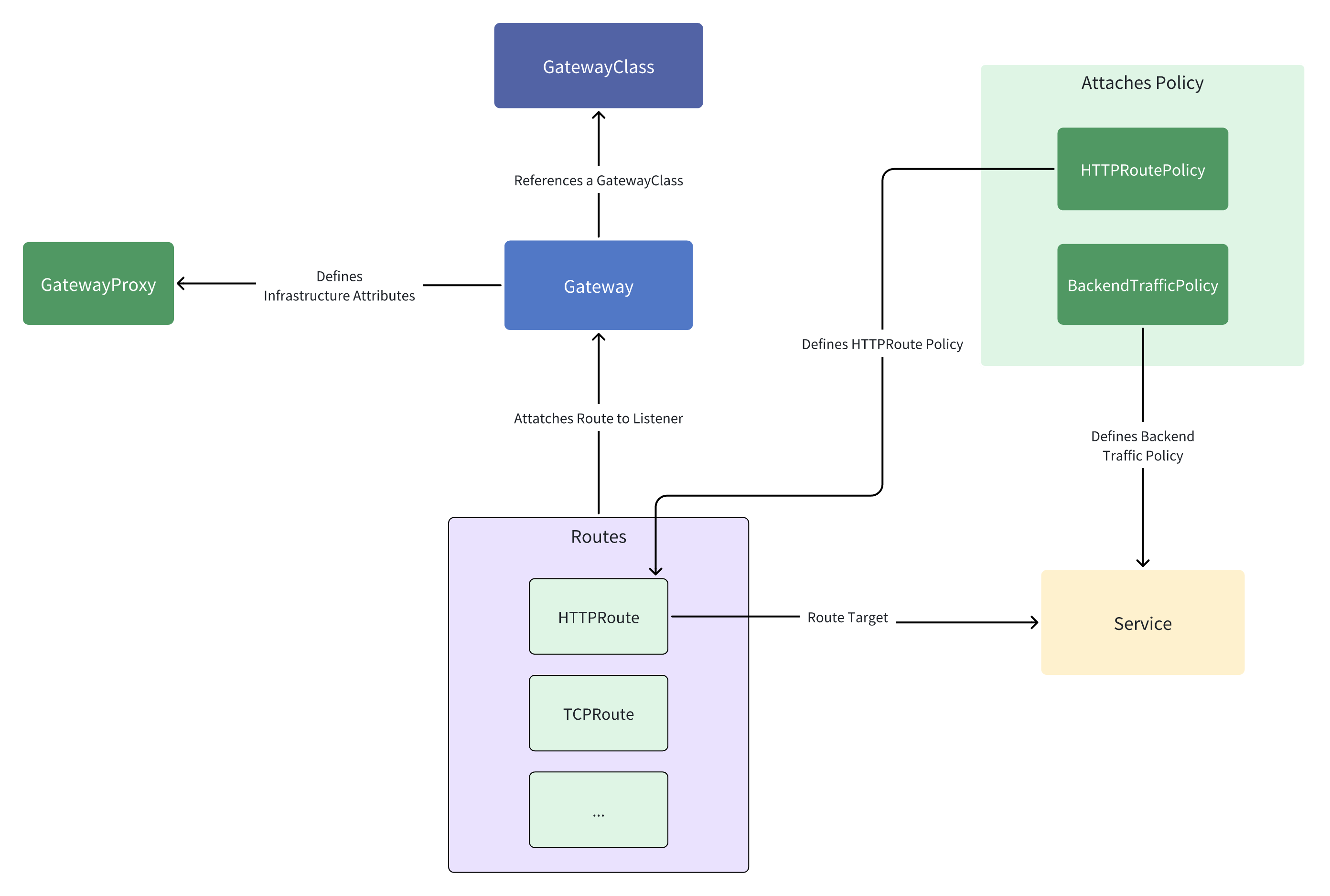
Enable additional features not included in the standard Kubernetes Gateway API, developed and maintained by Gateway API implementers to extend functionality securely and reliably.
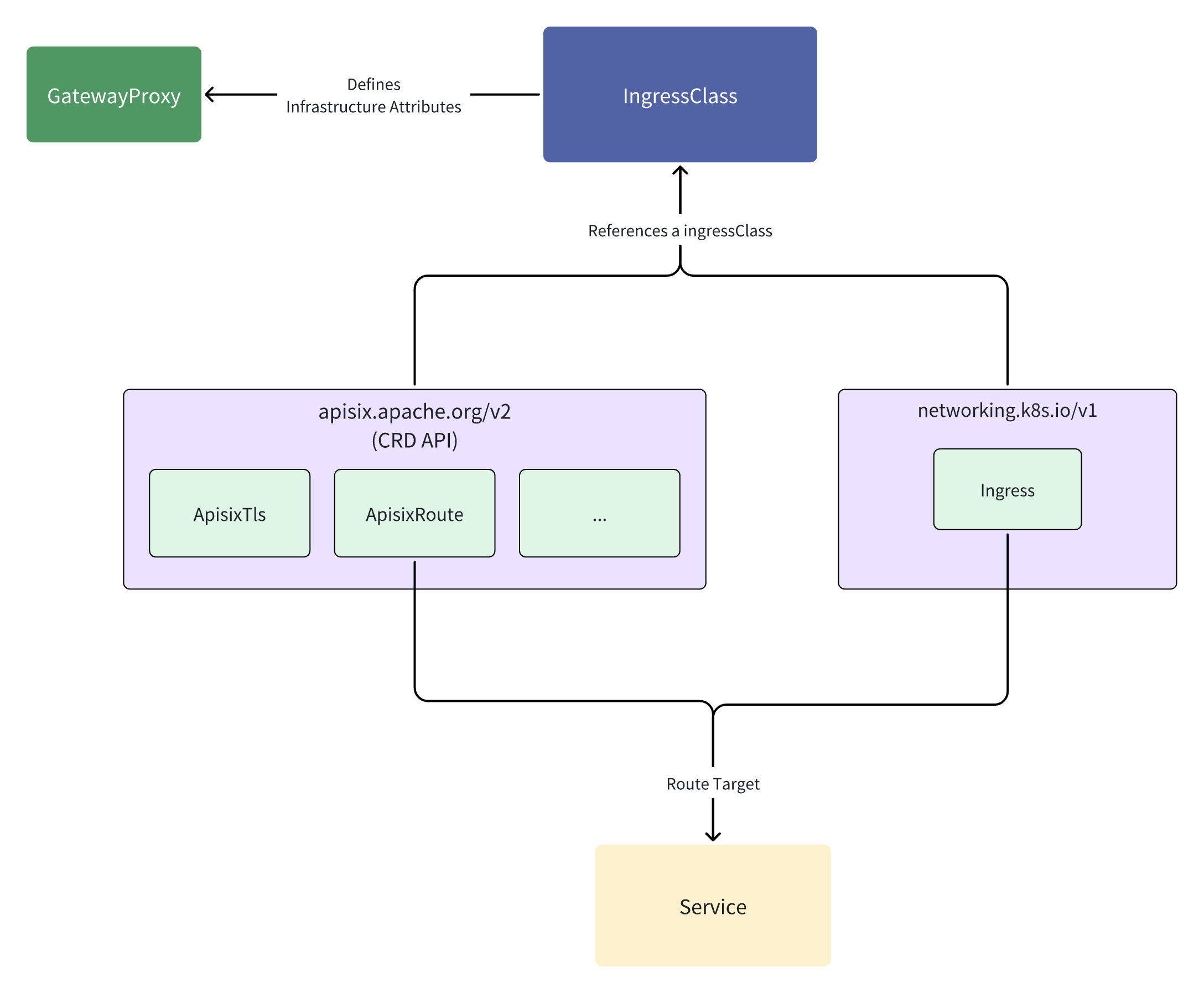
GatewayProxy: Defines connection settings between the APISIX Ingress Controller and APISIX, including auth, endpoints, and global plugins. Referenced via parametersRef in Gateway, GatewayClass, or IngressClass
BackendTrafficPolicy: Defines traffic management settings for backend services, including load balancing, timeouts, retries, and host header handling in the APISIX Ingress Controller.
Consumer: Defines API consumers and their credentials, enabling authentication and plugin configuration for controlling access to API endpoints.
PluginConfig: Defines reusable plugin configurations that can be referenced by other resources like HTTPRoute, enabling separation of routing logic and plugin settings for better reusability and manageability.
HTTPRoutePolicy: Configures advanced traffic management and routing policies for HTTPRoute or Ingress resources, enhancing functionality without modifying the original resources.
Ingress API Extensions#
APISIX Ingress Controller CRDs extend Kubernetes functionality to provide declarative configuration management for the Apache APISIX gateway, supporting advanced routing, traffic management, and security policies.
ApisixRoute#
ApisixRoute defines HTTP, TCP, and UDP routing rules with request matching and backend Service configuration. Use it when a route needs APISIX-specific capabilities that are not represented by the standard Kubernetes Ingress API. An ApisixRoute can also reference ApisixUpstream and ApisixPluginConfig resources to separate upstream and plugin configuration from the route.
Follow Configure Routes for a working ApisixRoute example. See the ApisixRoute API reference for its complete schema.
ApisixUpstream: Extends Kubernetes Services with advanced configurations such as load balancing, health checks, retries, timeouts, and service subset selection.
ApisixConsumer: Defines API consumers, their authentication credentials, and consumer-scoped plugins, supporting methods like basicAuth, keyAuth, jwtAuth, hmacAuth, wolfRBAC, and ldapAuth. Labels from
metadata.labelsare propagated to the APISIX consumer.ApisixPluginConfig: Defines reusable plugin configurations referenced by ApisixRoute through the plugin_config_name field, promoting separation of routing logic and plugin settings.
ApisixTls: Manages SSL/TLS certificates, supporting SNI binding and mutual TLS for secure APISIX gateway connections.