2026 Monthly Report (May 01 - May 31)
On this page
- Introduction
- Contributor Statistics
- Feature Highlights
- 1. Default hmac-auth Signed Headers to date
- 2. Add feishu-auth Plugin
- 3. Add graphql-limit-count Plugin
- 4. Add error-page Plugin
- 5. Add dingtalk-auth Plugin
- 6. Support Absolute Callback URLs in cas-auth
- 7. Honor Vary Header in proxy-cache Memory Strategy
- 8. Sign Request URI Cookie and Tighten Cookie Attributes in cas-auth
- 9. Support Configurable Request JSON Library
- 10. Add acl Plugin
- 11. Add data-mask Plugin
- 12. Add Safer proxy-cache Options
- 13. Add exit-transformer Plugin
- 14. Add traffic-label Plugin
- 15. Add oas-validator Plugin
- 16. Support Bedrock ConverseStream Streaming in ai-proxy Plugin
- 17. Support Dynamic Indexes in elasticsearch-logger Plugin
- 18. Rewrite Anthropic-to-OpenAI Converter with Whitelist Body Construction
- 19. Add Passthrough Protocol for Unrecognized AI API Formats
- Good First Issue
- Issue #13395
- Conclusion
Recently, we’ve introduced and updated some new features, including new authentication plugins for Feishu and DingTalk, GraphQL request cost limiting, OpenAPI request validation, safer proxy caching, and expanded AI proxy protocol support. For more details, please read this month’s newsletter.
Introduction
From its inception, the Apache APISIX project has embraced the ethos of open-source community collaboration, propelling it into the ranks of the most active global open-source API gateway projects. The proverbial wisdom of ‘teamwork makes the dream work’ rings true in our way and is made possible by the collective effort of our community.
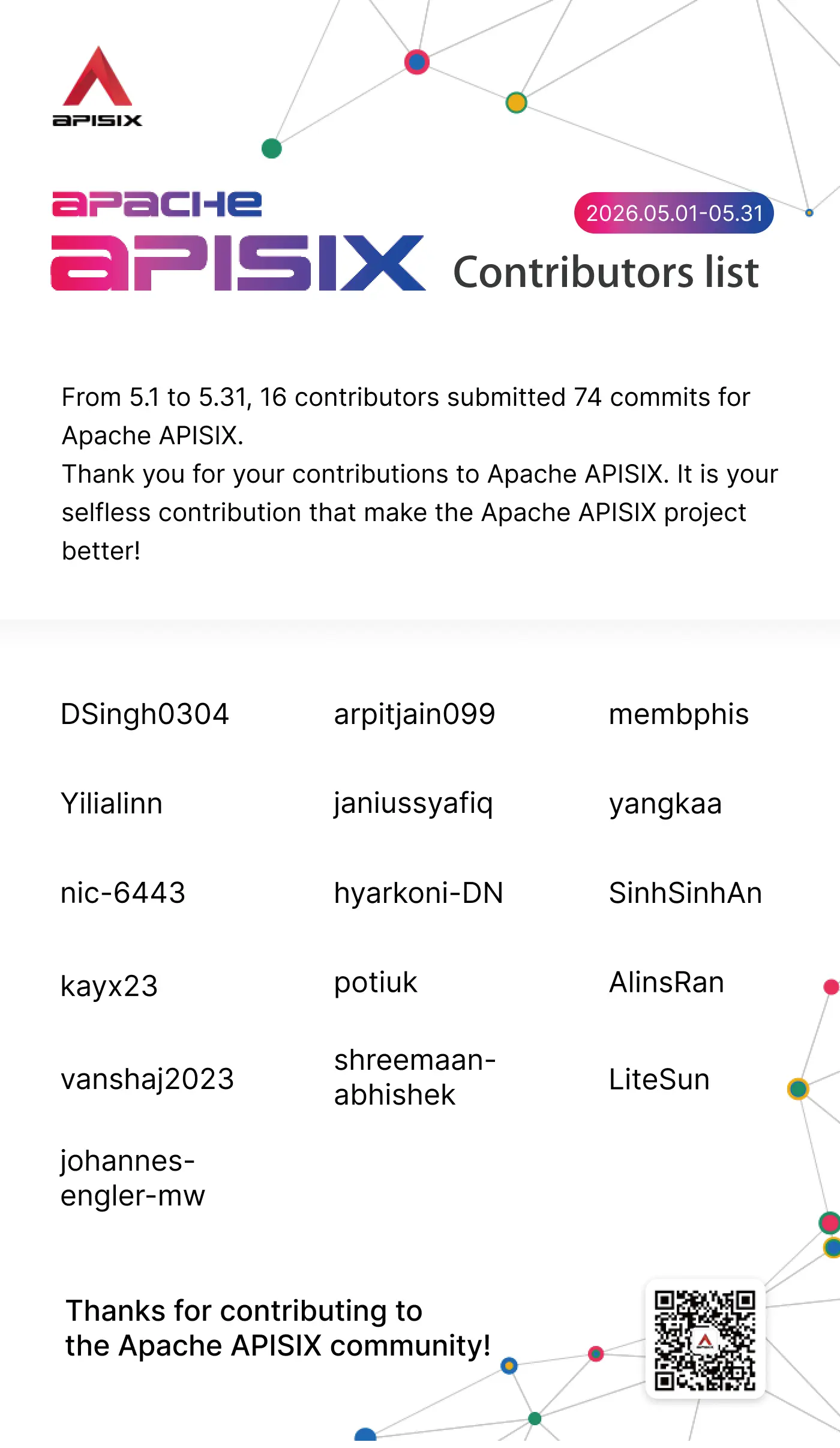
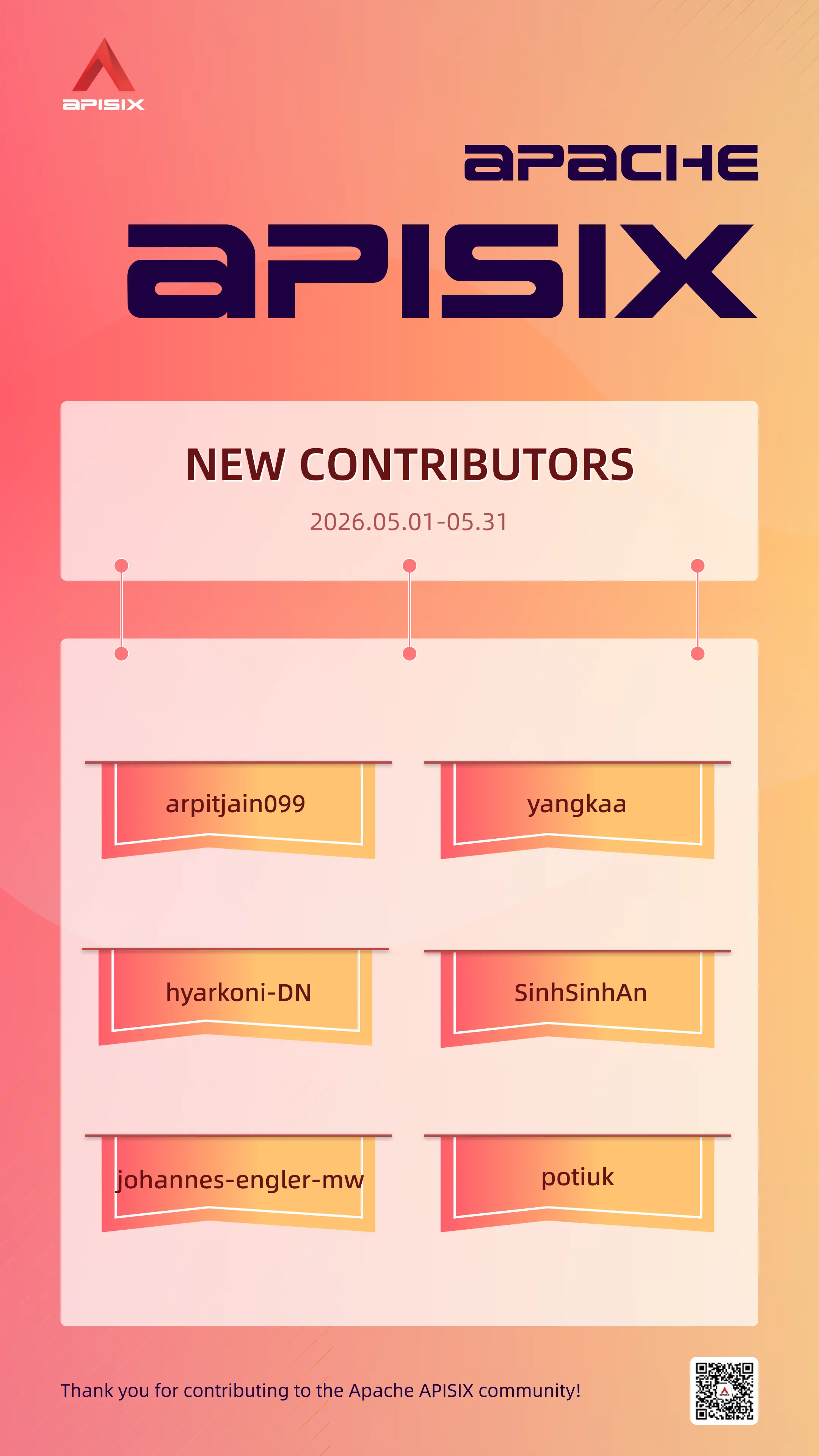
From May 1st to May 31st, 16 contributors made 74 commits to Apache APISIX. We sincerely appreciate your contributions to Apache APISIX.
Contributor Statistics
Feature Highlights
1. Default hmac-auth Signed Headers to date
PR: https://github.com/apache/apisix/pull/13388
Contributor: shreemaan-abhishek
This PR updates the hmac-auth plugin so signed_headers defaults to ["date"]. By binding the request Date header into the HMAC signature unless users explicitly opt out, APISIX better aligns the default behavior with its clock-skew protection and reduces the risk of stale signed requests.
2. Add feishu-auth Plugin
PR: https://github.com/apache/apisix/pull/13382
Contributor: AlinsRan
This PR adds the feishu-auth plugin, enabling browser-based API authentication through the Feishu (Lark) OAuth 2.0 authorization code flow. It helps teams protect internal APIs and developer portals with their existing Feishu identity system instead of building a custom authentication layer in each upstream service.
3. Add graphql-limit-count Plugin
PR: https://github.com/apache/apisix/pull/13372
Contributor: AlinsRan
This PR introduces the graphql-limit-count plugin, which limits GraphQL traffic based on query AST depth within a configured time window. It gives operators a better control surface for GraphQL APIs, where deeply nested queries can be much more expensive than ordinary request-count based rate limiting suggests.
4. Add error-page Plugin
PR: https://github.com/apache/apisix/pull/13380
Contributor: AlinsRan
This PR adds the error-page plugin for customizing APISIX-generated HTTP error responses, such as route-not-found or upstream-unavailable responses. Operators can configure response bodies and content types through plugin metadata, improving the user-facing experience for gateway-level failures.
5. Add dingtalk-auth Plugin
PR: https://github.com/apache/apisix/pull/13381
Contributor: AlinsRan
This PR adds the dingtalk-auth plugin, integrating DingTalk OAuth 2.0 authentication into APISIX routes. The plugin verifies users through DingTalk and stores the result in an encrypted cookie session, reducing repeated calls to DingTalk APIs during a user’s session.
6. Support Absolute Callback URLs in cas-auth
PR: https://github.com/apache/apisix/pull/13413
Contributor: shreemaan-abhishek
This PR allows cas-auth users to configure cas_callback_uri as an absolute URL. This is useful in deployments where APISIX sits behind proxies or external hostnames, because the CAS service URL can now be set explicitly instead of being derived from the incoming request host.
7. Honor Vary Header in proxy-cache Memory Strategy
PR: https://github.com/apache/apisix/pull/13376
Contributor: shreemaan-abhishek
This PR teaches the in-memory proxy-cache strategy to respect upstream Vary response headers. Requests that differ by headers such as Accept-Encoding can now be cached as separate variants, bringing memory-cache behavior closer to the disk strategy and preventing accidental cache collisions.
8. Sign Request URI Cookie and Tighten Cookie Attributes in cas-auth
PR: https://github.com/apache/apisix/pull/13331
Contributor: shreemaan-abhishek
This PR strengthens cas-auth by signing the CAS_REQUEST_URI cookie with HMAC-SHA256 and validating it on callback with a constant-time comparison. It also validates the recovered redirect target as a same-origin path, helping prevent unsafe redirects when the cookie is missing, malformed, or tampered with.
9. Support Configurable Request JSON Library
PR: https://github.com/apache/apisix/pull/13386
Contributor: nic-6443
This PR adds an APISIX-level JSON library selector for request body parsing and AI upstream request body encoding. Users can choose between cjson, simdjson, and experimental qjson, making it easier to balance compatibility and performance for large JSON request bodies.
10. Add acl Plugin
PR: https://github.com/apache/apisix/pull/13349
Contributor: AlinsRan
This PR introduces the acl plugin, which provides label-based access control for API routes. Teams can use consumer labels or external attributes such as roles, teams, or subscription tiers to enforce access policies without writing custom plugins.
11. Add data-mask Plugin
PR: https://github.com/apache/apisix/pull/13347
Contributor: AlinsRan
This PR adds the data-mask plugin to mask or redact sensitive fields from request query parameters, headers, and bodies before they appear in access logs or logger plugin outputs. It helps reduce exposure of credentials, tokens, personal data, and payment information in observability pipelines.
12. Add Safer proxy-cache Options
PR: https://github.com/apache/apisix/pull/13350
Contributor: shreemaan-abhishek
This PR adds consumer_isolation and cache_set_cookie options to the proxy-cache plugin. By isolating cache entries per consumer by default and refusing to cache Set-Cookie responses unless explicitly enabled, APISIX makes shared caching safer for authenticated or personalized traffic.
13. Add exit-transformer Plugin
PR: https://github.com/apache/apisix/pull/13343
Contributor: AlinsRan
This PR introduces the exit-transformer plugin and extends APISIX response handling with an exit callback mechanism. Users can transform APISIX-generated exit responses, such as plugin rejections or route-not-found responses, using custom Lua functions before the response reaches the client.
14. Add traffic-label Plugin
PR: https://github.com/apache/apisix/pull/13342
Contributor: AlinsRan
This PR adds the traffic-label plugin, which assigns configurable labels to requests using weighted random distribution rules. Labels can be written to request headers or APISIX variables, enabling traffic segmentation patterns such as experiments, routing hints, or policy-driven tagging.
15. Add oas-validator Plugin
PR: https://github.com/apache/apisix/pull/13344
Contributor: AlinsRan
This PR introduces the oas-validator plugin for validating inbound HTTP requests against an OpenAPI Specification 3.x document before forwarding them upstream. Invalid requests can be rejected with a configurable status code, helping API providers enforce contracts at the gateway layer.
16. Support Bedrock ConverseStream Streaming in ai-proxy Plugin
PR: https://github.com/apache/apisix/pull/13307
Contributor: shreemaan-abhishek
This PR extends the Bedrock provider in ai-proxy with ConverseStream support. APISIX can now route streaming Bedrock requests, parse AWS EventStream framing, and forward streaming model responses through the same provider abstraction used by other AI protocols.
17. Support Dynamic Indexes in elasticsearch-logger Plugin
PR: https://github.com/apache/apisix/pull/13334
Contributor: nic-6443
This PR enables dynamic index patterns in the elasticsearch-logger plugin using date/time placeholders and APISIX variables. Index names are resolved per request without mutating plugin configuration, allowing use cases such as daily index rotation or host-based log separation.
18. Rewrite Anthropic-to-OpenAI Converter with Whitelist Body Construction
PR: https://github.com/apache/apisix/pull/13321
Contributor: nic-6443
This PR rewrites the Anthropic Messages to OpenAI Chat Completions converter in ai-proxy to build outgoing request bodies from an explicit whitelist. The new approach avoids leaking unsupported Anthropic-specific fields to OpenAI-compatible upstreams and makes protocol translation more predictable.
19. Add Passthrough Protocol for Unrecognized AI API Formats
PR: https://github.com/apache/apisix/pull/13320
Contributor: shreemaan-abhishek
This PR adds a passthrough protocol adapter to ai-proxy for non-empty JSON request bodies that do not match a known AI protocol. It allows APISIX to proxy OpenAI-compatible or custom endpoints such as image generation APIs without forcing every payload shape through a specialized parser.
Good First Issue
Issue #13395
Link: https://github.com/apache/apisix/issues/13395
Description: The hmac-auth plugin documentation has a body-validation example where the request body Digest header is computed and sent, but the Digest header is not included in the HMAC signed headers list or the signing string. This makes the example slightly misleading: it appears to demonstrate end-to-end body integrity, but the body digest is not actually bound to the signature.
Expected Behavior: Update the hmac-auth documentation example so the SHA-256 body digest is computed first, then included in the signing string as digest: SHA-256=<base64 body digest>. The Authorization header should also include digest in the signed headers list, such as headers="@request-target date digest". It would also be helpful to add a short note explaining that validate_request_body checks the Digest header against the request body, and users who want the body bound to the signature should include Digest in the signed headers.
Conclusion
The official website and GitHub Issues of Apache APISIX provide a wealth of documentation of tutorials, and real-world use cases. If you encounter any issues, you can refer to the documentation, search for keywords in Issues, or participate in discussions on Issues to share your ideas and practical experiences.