
2026 Monthly Report (June 01 - June 30)

Recently, we’ve introduced and updated some new features, including SAML authentication, GraphQL caching, route-level proxy buffering, richer AI observability, new LLM security and cache plugins, safer request-body handling, and enhanced rate limiting backends. For more details, please read this month’s newsletter.
Introduction
From its inception, the Apache APISIX project has embraced the ethos of open-source community collaboration, propelling it into the ranks of the most active global open-source API gateway projects. The proverbial wisdom of ‘teamwork makes the dream work’ rings true in our way and is made possible by the collective effort of our community.
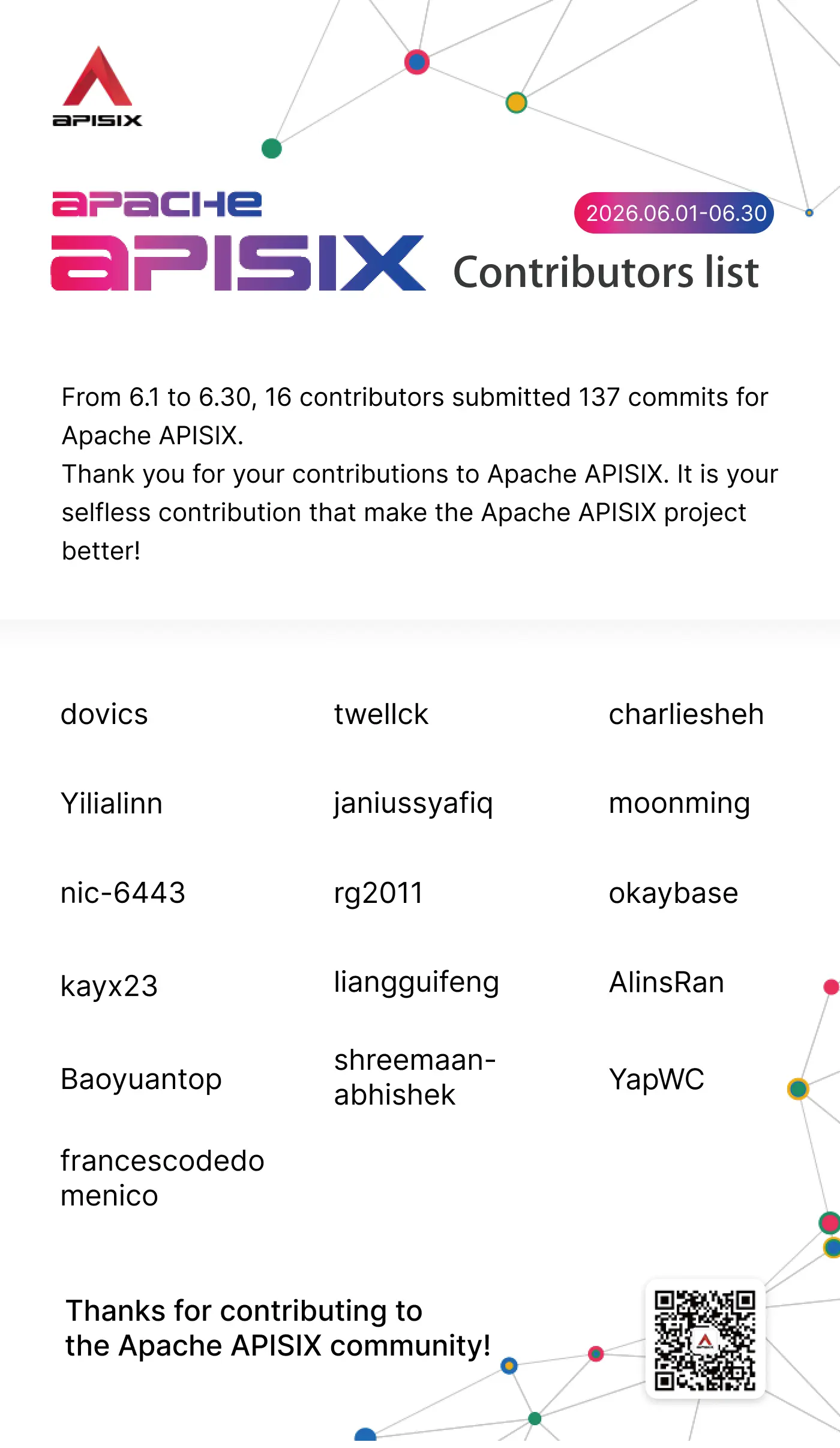
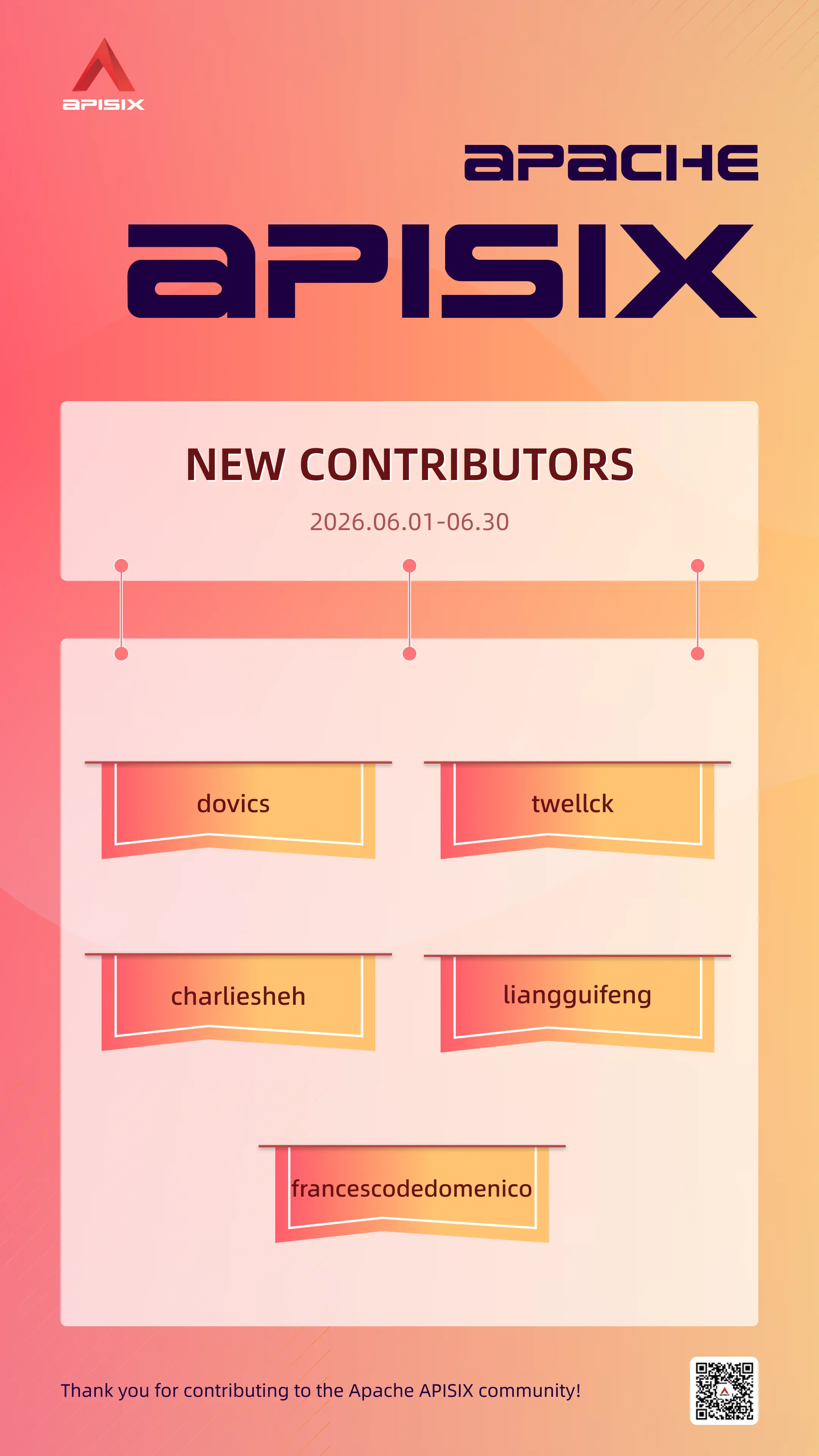
From June 1st to June 30th, 16 contributors made 137 commits to Apache APISIX. We sincerely appreciate your contributions to Apache APISIX.
Contributor Statistics
Feature Highlights
Here are the key updates from this month, grouped by capability area.
Authentication and Identity
1. Add saml-auth Plugin
PR: https://github.com/apache/apisix/pull/13346
Contributor: AlinsRan
This PR adds the saml-auth plugin, bringing SAML 2.0 authentication to the APISIX gateway layer. Organizations that rely on SAML identity providers can now protect upstream services through APISIX without implementing SAML handling in each application.
2. Make client_secret Optional for Local JWT Verification in openid-connect
PR: https://github.com/apache/apisix/pull/13472
Contributor: AlinsRan
This PR makes client_secret optional in openid-connect modes where APISIX only validates bearer tokens locally, such as public-key or JWKS-based JWT verification. Users no longer need to provide dummy secrets for flows that never call the identity provider’s token or introspection endpoints.
3. Remove Server-Side Token Generation Endpoint from jwe-decrypt
PR: https://github.com/apache/apisix/pull/13464
Contributor: shreemaan-abhishek
This PR removes the unfinished /apisix/plugin/jwe/encrypt helper endpoint from the jwe-decrypt plugin. APISIX now focuses on decrypting JWEs at the gateway, while token generation remains the responsibility of the service that owns the consumer secret.
4. Add max_req_body_size to hmac-auth
PR: https://github.com/apache/apisix/pull/13478
Contributor: shreemaan-abhishek
This PR adds a max_req_body_size option to hmac-auth for routes that enable request body validation. Oversized bodies can now be rejected before APISIX buffers them into memory, improving protection for deployments where the global NGINX body size limit is raised or disabled.
5. Update openid-connect Session Configuration for lua-resty-session 4.x
PR: https://github.com/apache/apisix/pull/13178
Contributor: francescodedomenico
This PR updates the openid-connect session configuration schema to match lua-resty-session 4.x. Session options are now exposed under their real names and validated explicitly, so settings such as session expiry actually take effect instead of being silently ignored.
Traffic Handling and Request Safety
6. Add graphql-proxy-cache Plugin
PR: https://github.com/apache/apisix/pull/13435
Contributor: AlinsRan
This PR introduces the graphql-proxy-cache plugin, which caches GraphQL query responses using APISIX’s existing proxy-cache infrastructure. It helps reduce repeated upstream work for cacheable GraphQL operations while supporting both disk and memory cache strategies.
7. Add proxy-buffering Plugin
PR: https://github.com/apache/apisix/pull/13446
Contributor: AlinsRan
This PR adds the proxy-buffering plugin to control NGINX proxy buffering behavior per route. Disabling buffering allows APISIX to stream responses directly to clients, which is important for Server-Sent Events, streaming APIs, and other real-time delivery scenarios.
8. Bound Request Body Reads in forward-auth and ai-proxy
PR: https://github.com/apache/apisix/pull/13466
Contributor: shreemaan-abhishek
This PR adds max_req_body_size to forward-auth, ai-proxy, and ai-proxy-multi. The new limit prevents these plugins from buffering arbitrarily large client bodies into worker memory and returns 413 for oversized requests before parsing.
9. Bound Pipeline Item Count and Schema in batch-requests
PR: https://github.com/apache/apisix/pull/13492
Contributor: shreemaan-abhishek
This PR hardens the batch-requests plugin by adding a configurable max_pipeline_items limit, requiring positive timeout values, and rejecting undocumented fields in pipeline entries. A single batch request can no longer fan out into an unbounded number of internal requests.
10. Support Per-Port PROXY Protocol for Stream TCP Proxy
PR: https://github.com/apache/apisix/pull/13561
Contributor: nic-6443
This PR adds per-port PROXY protocol controls for stream TCP proxy entries. Instead of applying PROXY protocol globally to every stream TCP port, users can enable accepting or sending it on specific ports while preserving the existing global defaults.
11. Add max_post_args_readable_size for post_arg.* Matching
PR: https://github.com/apache/apisix/pull/13601
Contributor: shreemaan-abhishek
This PR adds apisix.max_post_args_readable_size to bound request body reads during post_arg.* route matching. Large JSON or multipart bodies are no longer parsed into worker memory for route predicates; instead, oversized bodies simply do not match those predicates.
AI Gateway Security, Caching, and Resilience
12. Add Fallback Retry Controls to ai-proxy-multi
PR: https://github.com/apache/apisix/pull/13495
Contributor: AlinsRan
This PR adds max_retries and retry_on_failure_within_ms to ai-proxy-multi fallback behavior. Operators can bound how many alternate LLM instances a request tries and avoid retrying slow failures that would only increase latency and provider cost.
13. Add fail_mode for Consumer-Bound AI Plugin Handling
PR: https://github.com/apache/apisix/pull/13489
Contributor: AlinsRan
This PR adds a shared fail_mode mechanism for AI security plugins bound at the Consumer or Service level. Plugins can now consistently skip, warn, or fail closed when they receive plain HTTP, non-JSON, or non-AI requests that cannot be inspected.
14. Add ai-lakera-guard Plugin
PR: https://github.com/apache/apisix/pull/13570
Contributor: janiussyafiq
This PR adds the ai-lakera-guard plugin, integrating APISIX with Lakera Guard to scan LLM requests at the gateway. It helps protect AI applications from prompt injection, jailbreaks, PII leakage, policy violations, and malicious links before traffic reaches backend LLM services.
15. Improve ai-aliyun-content-moderation Performance and Request Scope
PR: https://github.com/apache/apisix/pull/13598
Contributor: nic-6443
This PR optimizes ai-aliyun-content-moderation by replacing O(n²) content chunking with an O(n) approach, reducing signing overhead, and reusing HTTP connections within a request. It also adds role-aware request_check_mode, allowing moderation to focus on the latest user input instead of rechecking the full conversation every turn.
16. Add ai-cache Plugin
PR: https://github.com/apache/apisix/pull/13578
Contributor: janiussyafiq
This PR adds the ai-cache plugin, which caches LLM responses for repeated requests that resolve to the same prompt and AI instance. It can reduce upstream token cost and latency for repetitive AI workloads such as FAQ bots, document Q&A, and translation.
17. Add Response Scanning to ai-lakera-guard
PR: https://github.com/apache/apisix/pull/13606
Contributor: janiussyafiq
This PR extends ai-lakera-guard with response scanning for both non-streaming and streaming LLM traffic. Users can configure the plugin to inspect input, output, or both, and flagged responses are replaced with provider-compatible denial messages.
Observability and Logging
18. Add Built-In LLM Histograms to Prometheus Metrics
PR: https://github.com/apache/apisix/pull/13487
Contributor: AlinsRan
This PR enriches Prometheus metrics for AI Gateway traffic with clearer latency and token distribution data. APISIX now distinguishes total LLM latency from streaming time to first token and exposes prompt and completion token histograms for quantile-based monitoring.
19. Add Built-In NGINX Variables for LLM Observability
PR: https://github.com/apache/apisix/pull/13477
Contributor: AlinsRan
This PR adds eight built-in $llm_* NGINX variables populated automatically by ai-proxy. These variables expose LLM request and response metadata in access logs and logger plugins without requiring custom parsing or additional plugin configuration.
20. Support Disabling Prometheus Labels to Reduce Cardinality
PR: https://github.com/apache/apisix/pull/13202
Contributor: janiussyafiq
This PR adds a disabled_labels option to Prometheus plugin metadata. Operators can collapse selected built-in label values to reduce metric cardinality while keeping the metric schema stable for dashboards, alerts, and recording rules.
21. Add log_format_extra to Enrich Default Logger Output
PR: https://github.com/apache/apisix/pull/13568
Contributor: shreemaan-abhishek
This PR adds log_format_extra, an additive logging format that preserves APISIX’s default rich log entry and overlays user-defined fields. It also exposes upstream_unresolved_host, making it easier to log the configured upstream hostname alongside the resolved upstream address.
22. Include AI Observability Variables in llm_summary
PR: https://github.com/apache/apisix/pull/13609
Contributor: nic-6443
This PR adds AI observability fields such as stream mode, tool-call metadata, cache token counts, reasoning tokens, and content risk level to llm_summary. Logger plugins can now receive a fuller AI request summary automatically instead of requiring every $llm_* variable to be added manually.
Rate Limiting and Credential Protection
23. Add Redis Sentinel, Sliding Window, and Delayed Sync to limit-count
PR: https://github.com/apache/apisix/pull/13443
Contributor: AlinsRan
This PR expands limit-count with a Redis Sentinel backend, sliding window support, and delayed sync for Redis-based policies. These options improve high availability, reduce fixed-window burstiness, and lower per-request Redis overhead on high-traffic routes.
24. Encrypt Redis Passwords in Rate Limiting Plugins
PR: https://github.com/apache/apisix/pull/13624
Contributor: nic-6443
This PR adds redis_password and sentinel_password fields to encrypt_fields for limit-count, limit-req, and limit-conn. When data encryption is enabled, Redis credentials used by rate limiting plugins are now encrypted at rest in etcd and decrypted transparently at runtime.
Conclusion
The official website and GitHub Issues of Apache APISIX provide a wealth of documentation of tutorials, and real-world use cases. If you encounter any issues, you can refer to the documentation, search for keywords in Issues, or participate in discussions on Issues to share your ideas and practical experiences.